


“The Golden Skate”: 1910, the birth of an endurance myth

A winter night where it all begins
On December 24, 1910, in the heart of the Vélodrome d'Hiver, the famous Vel d'Hiv, Paris became the scene of a silent sporting revolution. Under the immense metal glass roof, bathed in an almost unreal artificial light, a handful of men set off for an unprecedented challenge: to last 24 hours on roller skates, without interruption .
At that time, the Vel d'Hiv was much more than just a sports venue. A true cathedral of modern sport, it embodied a society fascinated by performance, endurance, and extraordinary feats. Designed for cycling, this covered velodrome was already hosting long-distance races, popular shows, and physical challenges that captivated an ever-growing audience.
But that night, one detail changed everything.
These are not bicycles that turn.
They are men on wheels.
Henri Desgrange, the man behind the idea

Behind this extraordinary event is a major figure in French sport: Henri Desgrange, already famous for having created the Tour de France cycling race in 1903.
A visionary and fervent advocate of sport as a school of willpower, Desgrange saw endurance as the ultimate expression of human transcendence. With the “Golden Skate,” he transposed to roller skating the principles that had made cycling so successful: duration, resistance, and the drama of effort.
*Source: This image was extracted from another file: Mr. Desgrange (portrait of the editor-in-chief of the newspaper L'Auto at his desk)
*
This 24-hour format is not insignificant. It pushes athletes to their limits, exposes them to extreme fatigue and lack of sleep, and transforms the competition into a true mental as well as physical ordeal.
With this race, Desgrange is not just creating an event.
It lays the foundations for a discipline.
The Vel d'Hiv, a scene of exploits

The Vélodrome d'Hiver is a unique place. Its oval, banked wooden track is designed for speed, but here it becomes an experimental ground for roller skating.
The smooth surface makes for a fast ride, but the turns demand constant technical mastery. With each lap, skaters must contend with gravity, muscle fatigue, and the precision of their trajectories.
Around the track, the stands are packed. Thousands of spectators take turns, some staying all night, fascinated by this unprecedented spectacle. The atmosphere is electric, almost surreal: people applaud, watch, and wonder… how far can they go?
Because beyond the competition, it is a fight against time that is taking place.
A ruthless race unfolded
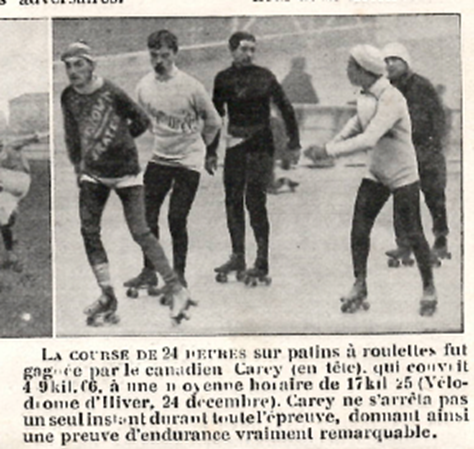
From the very first hours, the pace was high. The favorites set a sustained rhythm, seeking to quickly widen the gap. But very soon, the reality of the effort set in.
Night becomes the main adversary.
The cold, the monotony of the laps, the lack of precise temporal markers plunge the skaters into a kind of trance. Their bodies wear down, their movements become mechanical, their faces close off.
Unlike modern races, no scientific protocol guides the athletes. No precise nutritional strategy, little recovery, rudimentary equipment: wooden or metal wheels, rigid shoes, minimal comfort.
Every stoppage is costly. Every restart is a battle.
Some give up. Others slow down. Only a few hold on.
A spectacular race, minute by minute

The race started at precisely 4:15 PM, in front of nearly six hundred already captivated spectators. A dozen runners set off on the Vel d'Hiv track, unaware that only a few would reach the finish line.
From the opening laps, Canadian Carey set a smooth but steady pace, watched by a still calm, almost observant crowd. But around lap 60, the race came alive: the first attacks were launched, Leroy moved to the front, and Cookson and Curtiss accelerated in turn. The crowd reacted, applauding and erupting in cheers.
After an hour, the pace becomes frantic. Accelerations come one after another in a growing roar. The spectators, ever increasing in number, rise to their feet, cheering, thrilling with each overtake. Carey regains the lead with ease, impressing with his fluidity.
Two hours into the race, a clear selection has already been made. Of the 12 runners who started, only a few are still able to keep pace. Carey, Leroy, Curtiss, and Cookson are locked in a fierce battle, while others are beginning to fall behind. The atmosphere is becoming even more intense.
Around the 6-hour mark, the race took a dramatic turn. Pain set in, bodies grew weary, some stopped, others fell or were injured. But at the front, the battle continued. Carey didn't falter. Leroy, for his part, clung on intelligently, steady, and solid, refusing to give way.
By the eighth hour, the first big names were cracking: withdrawals, injuries, retirements. The public watched, fascinated, as this relentless selection process unfolded. Each lap became a feat. Each minute drew applause.
Then comes the night.
The atmosphere becomes almost surreal. Between fatigue and fascination, the spectators continue to stream in, also enduring the long haul. On the track, only a few survivors remain. Carey continues, tireless, never leaving the track. Leroy stays right behind him, clear-headed and determined.

By the 20th hour, only three drivers remained in contention. And in the final hours, it all came down to two men: Carey and Leroy.

A tense, silent, impressive struggle.
The audience holds its breath, aware they are witnessing something exceptional. Leroy tries, observes, but understands that Carey will not give in.
In the final minutes, the crowd rises to its feet, entirely devoted to these two heroes. A final burst of speed brings this extraordinary challenge to a close.
Carey wins, Leroy finishes just two kilometers behind.
In total, only 5 runners will complete these 24 hours.
More than a race, it was a total spectacle, fueled by an electric atmosphere and a fascinated crowd, witnessing a struggle that was as much physical as mental.
Carrey, the absolute feat


At the end of these 24 hours, one man emerged victorious: the Canadian Mr. Carrey .
His performance is simply extraordinary: 476.933 kilometers covered without any stops , representing an average speed of nearly 19.9 km/h. A feat all the more impressive as it was achieved in conditions that would be considered extreme today.
Behind him, Léveillé completes the podium in 3rd place with 422.666 kilometers.
But between these two performances, the man who will cross the finish line in second position is a name that will leave a lasting impression.
Leroy, a pioneer of modern endurance
Finishing second with 474.933 kilometers , less than two kilometers from victory, Leroy embodies another form of achievement.
Less spectacular in appearance, but perhaps more visionary.
Because Leroy wasn't simply a competitor: he was a central figure in the development of roller skating at the turn of the 20th century. He belonged to that generation of enthusiasts who, unknowingly, laid the foundations of modern roller skating. At a time when disciplines were not yet codified, he drew inspiration from training methods used in cycling and endurance racing, disciplines that were then booming.

Born in Paris in 1872, he was the rink manager at the Ideal Skating rink in the Palais d'Été from its opening. By 1910, he had already been teaching roller skating for ten years, a discipline which he himself helped to spread internationally, notably in Cairo, Alexandria and Constantinople.
His career has been decidedly international: after teaching in New York and London, he returned to Paris two years before this race, with a wealth of experience that was rare at the time.
But Leroy was also one of the first skaters to embrace a modern partnership model. He was sponsored by the skate brand Brampton , a rare occurrence at the time, which testified to his status and the recognition of his talent.

On the track, this experience is immediately apparent; he already has remarkable race management skills.
Where others succumb to the intensity of the start, Leroy adopts a steady, almost methodical pace. He anticipates fatigue, paces his effort, and accepts not being the fastest at every moment in order to maintain his performance over the long haul.
A strategy that strongly resonates with current practices.
By becoming the French record holder for the 24 hours, he did not settle for a place of honor.
It embodies an evolution.
The roots of a discipline
The “Golden Skate” goes far beyond the scope of a simple competition. It marks a turning point in the history of roller skating.
For the first time, endurance becomes an objective in itself. Skaters are no longer just looking for speed, but the ability to last, to manage, to resist.
Without realizing it, they are already experimenting:
● effort management
● the importance of rhythm
● mental resistance
● Adapting the equipment
These are all principles that structure major endurance events today.
A legacy that lives on
More than a century later, the echo of that December night in 1910 still resonates in major modern races, and in particular the 24 Hours Rollers of Le Mans.
A significant fact often overlooked: faced with the success of the “Golden Skate”, the experiment was renewed as early as 1911, confirming the interest of the public and athletes in this extraordinary format.

Then, after decades of interruption, the spirit of 24h Rollers was reborn in France in 1996 with the world record for 24 hours (alone and on road) established by Christophe Evart with 468.320 km.
The 24-hour roller skating race on the Le Mans circuit, organized for the first time in 2000, revives this unique endurance tradition.
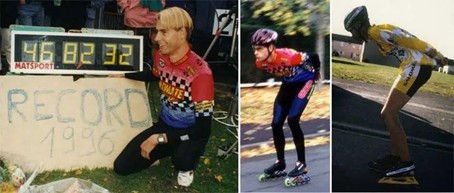
In every 24-hour race, in every relay, in every straight line covered at the end of fatigue, something of the Vel d'Hiv remains.
The spirit has transcended time.
The setting has changed, the equipment has evolved. Strategies have become more refined. Performances have exploded.


But the essential thing remains. To hold on. To resist. To move forward.
As in 1910, each skater is part of a story bigger than himself, that of pioneers like Leroy, like Carrey, like all those pioneers who, on a Parisian wooden track, transformed an insane challenge into a discipline in its own right.
A 24-hour story.
And already, a story for eternity. And a whole life devoted to skating.


Comments